> All in One 586

Ads

Tuesday, June 29, 2021

Lollipop AI launches online grocery marketplace where you can build your own recipes

As I’ve taken to online grocery shopping over the pandemic, I’ve always wondered why supermarkets didn’t offer simple ‘recipe’ features that would have automatically collected items for a homemade meal. It seemed an opportunity missed. But it is missed no more.

Lollipop AI, the new British online grocery marketplace, is launching its public beta today to do that, and it’s been created by a serial UK entrepreneur who was there at the start of successful UK startups Osper, Monzo and Curve.

Founder and CEO Tom Foster-Carter has envisaged a platform allowing people to build meal plans from recipes, assembling the ingredients automatically into their shopping baskets, and suggesting remaining household essentials. He says the Lollipop could well help with health goals, improve culinary skills and minimize food waste. Built as a marketplace, it will be partnering with Sainsbury’s and BBC Good Food with more partners, and fulfillment will be completed by retail partners. The business model will be taking a small commission from retail partners, allowing selected advertising, e.g. from CPG brand owners.

The site will be free to use, while a premium tier is planned. The first 10K beta testers to sign up to the waitlist will be offered access to premium features “for life,” says the startup, which will offer prices at the same rate as normal supermarkets.

Foster-Carter, who had the idea after having a baby and realizing he was spending hours trying to use a normal supermarket, says the approach will save several hours a week for the average household. (We will briefly note the fact that a man had to create a site like this after doing the weekly shop…). Lollipop claims 80% of households spend over an hour a week meal-planning and online grocery shopping.
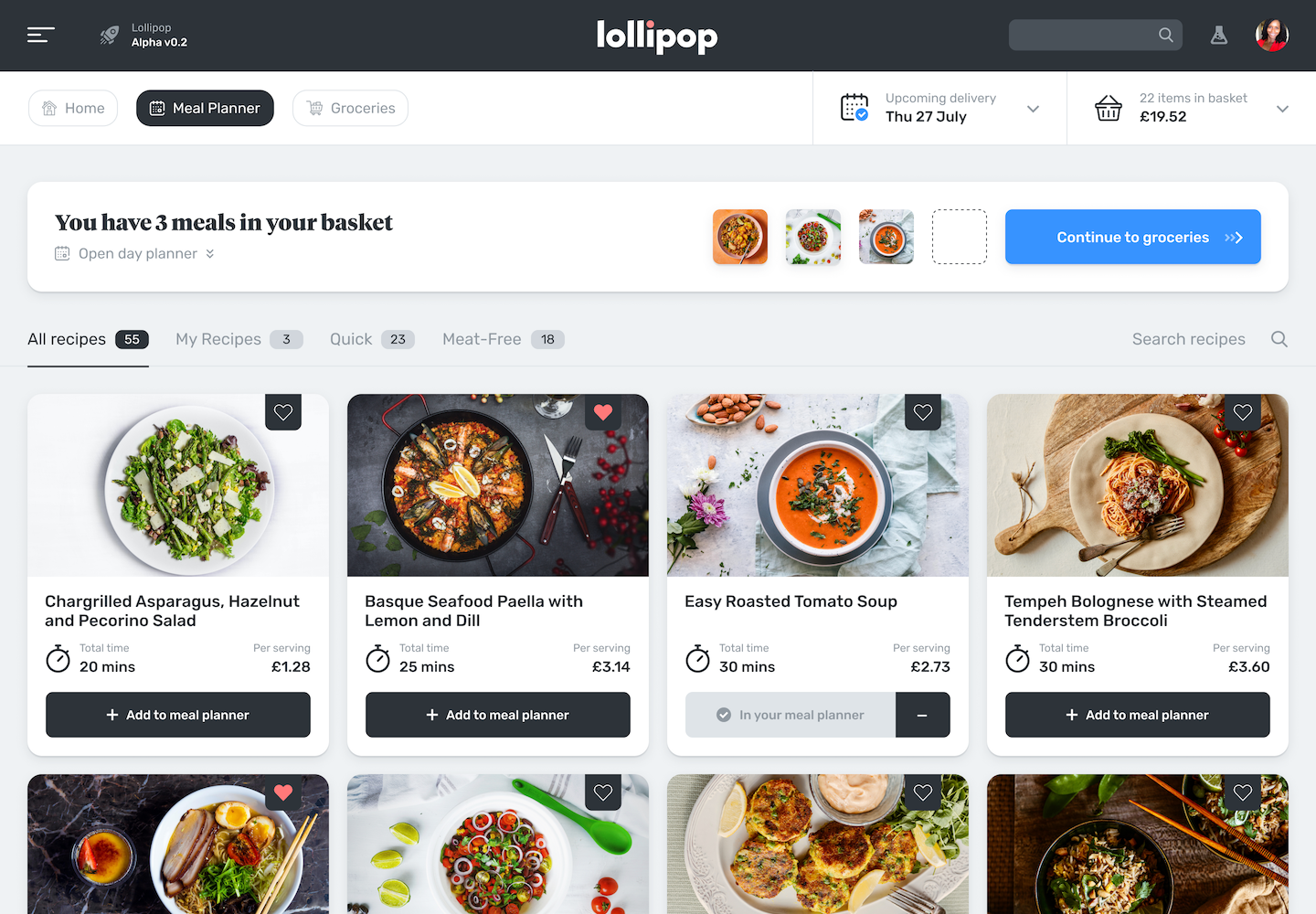
Lollipop MealPlanner

Lollipop MealPlanner

The founding team includes former employees of Monzo, Farmdrop, Amazon, Sainsbury’s and HelloFresh, such as cofounders Chris Parsons and Ib Warnerbring.

Although Foster-Carter is coy about how much he has raised for this approach, he says he has raised a pre-seed round backed by JamJar Investments, Speedinvest, and a “raft of grocery/technology big hitters” including Ian Marsh (former UK GM of HelloFresh) and former leadership and founders of online grocers in the U.K. and abroad plus ‘super angels’ Charles Songhurst and Ed Lando.

In particular, the site is likely to appeal to people looking to lose weight, as meal planning would be simpler and may even have an impact on recipe-box startups.

Lollipop is not alone in its ambitions. Jupiter.co in the U.S. bills itself as “groceries on autopilot”; Jow is recipe-led shopping, as is Side Chef; while Cooklist is a meal-planner + cooking support, also in the U.S.

Foster-Carter told me: “It’s a marketplace so we could partner with traditional supermarkets (Sainbury’s, Tescos, Waitrose etc) + online retailers (Ocado, Amazon), direct to farm / organic (Riverford, Farmdrop), mission-led single component (Oddbox, Milk & More, etc); recipe boxes (Gousto, Hello Fresh, Mindful Chef etc); and rapid delivery (Gorillas, Getir, Weezy, etc).

“This is just the start… The plan is to be the single place you go to for all your food needs – we’ll enable you to order your Deliveroo or restaurant kit (e.g. Dishpatch) from us. Groceries are delivered by our partners, and then when it’s time to cook you’ll be able to use a cooking companion app (due out next month). In the future you’ll be able to improve your cooking skills through Lollipop.”

Few players have nailed the ability to buy a lot of items (50-100+) really fast, not even Amazon – this might be Lollipop’s USP, if it can crack it.


from Amazon – TechCrunch https://ift.tt/3drrI5q
via IFTTT

What does `font: 110%/1.4 system-ui` mean?

I use this line, or one like it, in a lot of quick demos. Not that it’s not a production-worthy line of code—I just tend to be a bit more explicit on bigger projects.

html {
  font: 110%/1.4 system-ui;
}

Someone wrote in confused by it, and I could see how a line like that is a bit bewildering at first.

The first thing to know is that it is called shorthand. The font property in CSS gives you the opportunity to set a bunch of font-* properties all at once. In this case, we’re setting:

html {
  font-family: system-ui;
  font-size: 110%;
  line-height: 1.4;
}

There are a few more little specific things to know. For example, the order matters.

/* invalid */
html {
  font: system-ui 100%/1.4;
}

You also can’t set the line-height without also setting the font-size. If you’re going to set line-height, you have to set both. Be extra careful there because something like 20px is both a valid line-height and font-size, and if you only set one, it’ll be the font-size. If you go for a unitless number, which is a great idea for line-height, and try to set it alone, it’ll just fail.

/* invalid */
html {
  font: 1.5 system-ui;
}

Of course, we’ve got all this detailed in the Almanac entry for font. But I’ll also give a shout to Mateusz Hadryś who has a detailed article titled “Full Text Styling With a Single Line of CSS” with some detailed figures like this that are helpful in understanding everything:

Showing the font property declaration. Style, variant and weight are in yellow with a label above that says order doesn't matter and a label beneath saying these have to be first. Next is size with a forward slash then line-height in red. Above them is a label that says these have to be next to each other. Next is family in light blue with a label that says it has to be last. There is an additional white label that connects size and family that says they are required.

Lastly, if system-ui was part of the confusion there, that’s one of those System Things.


The post What does `font: 110%/1.4 system-ui` mean? appeared first on CSS-Tricks. You can support CSS-Tricks by being an MVP Supporter.


from CSS-Tricks https://ift.tt/3hh07oF
via IFTTT

If you pay an emotional labor fee, Postdates will get your stuff from your ex

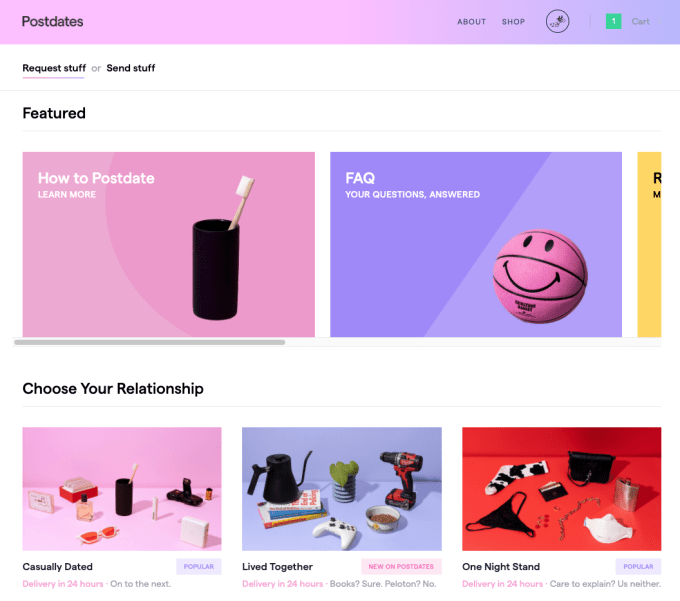
Yesterday, the team behind the parody Amazon Dating delivered us Postdates. It’s like Postmates, but for getting your stuff back from your ex.

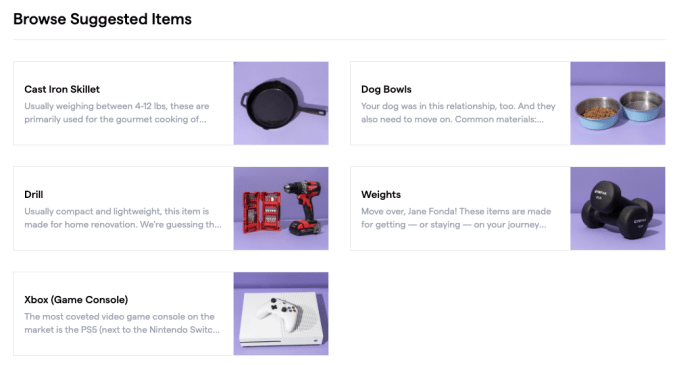
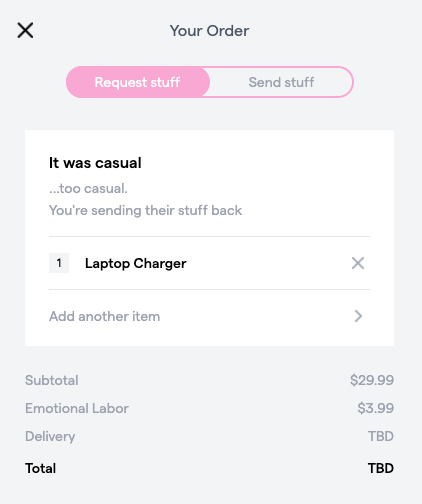
Postdates looks like the actual Postmates website – you can select a type of relationship (“casually dated,” “lived together,” “one night stand,” etc.) like it’s a type of restaurant. Then, you can choose from preset items to retrieve (concert tickets if you were friendzoned, family heirlooms if you were divorced) or add a custom item. Delivery starts at $25 in LA and $30 in NY, along with an additional emotional labor fee of $3.99. Yes, you can actually use this service if you’re in one of these two cities, but Postdates isn’t here to stay — it’s a pop-up business. Or, as Postdates “founder” Ani Acopian puts it, “It’s kind of like watching a ‘Black Mirror’ episode, but it’s your real life.”

You might remember Elon Musk’s failed comedy start-up/”intergalactic media empire” Thud, which aimed to create immersive digital experiences that blurred the lines between what’s real and fake. Or, you might not remember Thud, since it failed spectacularly and wasn’t very funny. Postdates struck the satire gold that Elon Musk dreamed of with Thud, only they did it without $2 million dollars in funding from one of the richest men in the world.

TechCrunch talked to conceptual artist Ani Acopian, producer Suzy Shinn, and product developer Brian Wagner to get the low-down on just how legit Postdates is.

TechCrunch: Why Postdates? How did the idea come about?

Suzy Shinn: At the start of quarantine when everything was falling apart, Ani and I made ScrubHub, like PornHub for hand washing. We raised $50,000 for charity.

Ani Acopian: I think we had this creative juice inside of us that we wanted to find an outlet for.

SS: Then, we had the Postdates idea, and we actually tried to get investors and artists to fund it, because we were like… This is going to cost something, we want to make it real and actually function. No one wanted anything to do with it, because they were like, “What’s the return?”

AA: And we were like, “Well, the return is that it’s a vibe.”

SS: No one wanted anything to do with us funding-wise, so we built it ourselves.

TC: So, you can actually use this?

AA: Yeah, we partnered with two local courier companies, Gourmet Runner in LA and Airpals in New York. We wanted to make sure we work with people that treat their workers right.

SS: You can put in a request, and the ex has to consent obviously and be like, “Yeah, I have this stuff for you, I’ll put it outside,” and our couriers have Postdates bags that we give to them. But legitimately, you can use it in both of those cities as long as you’re not sending a cat, or a child, or alcohol, or drugs, or something that won’t fit in a bag.

AA: We spent a lot of time on the workflow to make sure no addresses are shared, that everyone’s consenting to be involved, and we’re trying to keep it no-contact, so we’re asking people to put stuff on their door handle. You’re not charged until your ex accepts the order.

TC: You just launched yesterday, but have people actually been using the service so far?

Brian Wagner: We had some people who would post a screenshot in response to Ani’s tweet and be like, “Oh snap, I actually got Postdated by my ex!”

SS: There’s about 30 to 40 pending requests, and we’ve gotten a handful that just as of this morning have been delivered successfully.

TC: Do you think this could be a viable business?

AA: Not everything needs to be a viable business. I would actually be… not surprised, but upset if this actually became a thing, because I don’t think the world needs that level of stuff, but I think we’re pretty much already there. All you can do is hold the mirror up.

TC: As satire, what are you trying to say with Postdates?

SS: I think in the tech world, it seems like all of these tech startups get crazy amounts of funding, and they spend so much money, and they take themselves so seriously. The three of us, with the help of our friends, were able to do this, and we didn’t need $13 million in funding or five years. But we were staying up until like 5 AM, and we were like, “Can we hire someone to help us?” but we were like, “No, we can’t pay.”

BW: Especially with the rise of the gig economy, we’ve seen some positives and some pretty serious negatives, especially during quarantine. It helps people get the things that they need, but also, a lot of workers aren’t being paid fairly and don’t have health insurance. So there’s a sentiment a lot more often now that a lot of tech is redistributing labor, and you’re just paying for people to be moved around. So in a way, we’re sort of like… We’ve redistributed emotional labor here.

TC: There’s an emotional labor tax on the site, yeah.

BW: There’s a bit of poking fun of that, saying how far will we go in terms of actually moving labor along for money. Will people pay for someone else to deal with the emotional handling of a situation?

TC: How did Postdates build upon Amazon Dating?

AA: We’ve made two parody sites now, and we wanted to take that to the next level and make it experiential. It’s kind of like watching a Black Mirror episode, but it’s your real life.

SS: What is the literal price you will pay not to see someone? This is a real thing that happens all the time — my friends will be like, “I broke up with my girlfriend, I need you to go get my stuff,” and I’m like, “I don’t want to go get your stuff.”

AA: I don’t think we should outsource it, though.

TC: So you don’t think we should outsource it, but also, you made Postdates.

AA: I think that’s the whole…

TC: That’s the joke.

AA: Yeah.

TC: What does it say about startup culture to make a product that you don’t think should exist?

SS: Startups are so, so serious, there’s no humor in it, and they think it’s going to last forever. Well, we’re doing the opposite.  We’re going to make this last a couple of weeks for a limited time only, and then we’re gonna take it away. But we would love to keep doing these, making something where art meets tech meets entertainment.

BW: Companies and experiences can just be fun. They don’t have to be a billion dollar idea, they don’t have to be something that’s going to go on Shark Tank. Imagine us entering Shark Tank…


from Amazon – TechCrunch https://ift.tt/3hh1JP3
via IFTTT

Chromium spelling and grammar features

Delan Azabani digs into the (hopefully) coming soon ::spelling-error and ::grammar-error pseudo selectors in CSS. Design control is always nice. Hey, if we can style scrollbars and style selected text, why not this?

The squiggly lines that indicate possible spelling or grammar errors have been a staple of word processing on computers for decades. But on the web, these indicators are powered by the browser, which doesn’t always have the information needed to place and render them most appropriately. For example, authors might want to provide their own grammar checker (placement), or tweak colors to improve contrast (rendering).

To address this, the CSS pseudo and text decoration specs have defined new pseudo-elements ::spelling-error and ::grammar-error, allowing authors to style those indicators, and new text-decoration-line values spelling-error and grammar-error, allowing authors to mark up their text with the same kind of decorations as native indicators.

This is a unique post too, as Delan is literally the person implementing the feature in the browser. So there is all sorts of deep-in-the-weeds stuff about how complex all this is and what all the considerations are. Kinda like, ya know, web development. Love to see this. I’ve long felt that it’s weird there is seemingly such little communication between browser engineers and website authors, despite the latter being a literal consumer of the former’s work.

Direct Link to ArticlePermalink


The post Chromium spelling and grammar features appeared first on CSS-Tricks. You can support CSS-Tricks by being an MVP Supporter.


from CSS-Tricks https://ift.tt/344ZSHa
via IFTTT

Shopify drops its App Store commissions to 0% on developers’ first million in revenue

Following similar moves by Apple, Google, and more recently Amazon, among others, e-commerce platform Shopify announced today it’s also lowering its cut of developer revenue across its app marketplace, the Shopify App Store, as well as the new Shopify Theme Store. The news was announced today alongside a host of other developer-related news and updates for the Shopify platform at the company’s Unite 2021 Conference, including updates to Checkout, APIs, developer tooling and frameworks, among other things.

Shopify says its app developer partners earned $233 million in 2020 alone, more than 2018 and 2019 combined — an increase that can likely be attributed, in part, to the COVID-19 pandemic and the rapid shift to e-commerce that resulted. Today, there are over 6,000 publicly available apps across the Shopify App Store, and on average, a merchant will use around six apps to run their business.

Now, Shopify says it will drop its commissions on app developer revenue to 0%, down from 20%, for developers who make less than $1 million annually on its platform. This benchmark will also reset annually, giving developers — and, particularly those on the cusp of $1 million — more earning potential. And when Shopify’s revenue share kicks in, it will now only be 15% of “marginal” revenue. That means developers will pay 15% only on revenue they make that’s over the $1 million mark.

The same business model will apply to Shopify’s Theme Store, which opens to developer submissions July 15.

As the two stores are separate entities, the $1 million revenue share metric applies to each store individually. The new business model will begin on August 1, 2021 and will be made available to developers who register by providing their account details in their partner dashboard.

Shopify says the more developer-friendly business model will mean a drop in company revenue, but says it doesn’t expect this impact “to be material” because it will encourage greater innovation and development.

The changes to Shopify’s App Store follow a shift in the broader app store market around developer commissions.

Last year, amid increased regulatory scrutiny over how it runs its App Store, Apple announced it would reduce the App Store commissions for smaller businesses under a new program where developers earning up to $1 million per year would only have to pay a 15% commission on in-app purchases. Google and Amazon have since followed suit, each with their own particular spin on the concept. For example, in Google’s case, the fee is 15% on the first million the developer earns. Amazon is still charging a higher percentage at 20%, but is tacking on AWS credits as a perk.

Apple and Google, in particular, hope these changes can help shield them from antitrust investigations over their alleged app store monopolies, while also giving developers a better reason to participate in their own slice of the app economy.

Outside of mobile, Microsoft this year agreed to match the 12% cut on game sales that Epic Games takes on its Windows Store, as a means of increasing the pressure on its rivals. With the larger update to the new Windows 11 Store, it will allow developers to use their own payment platforms, while keeping its commission at 15% on apps.

To date, much of the momentum in the market has been focused on lowering the cut of app and games sales. Shopify’s app platform is different — it’s about apps that are used to enhance an e-commerce business, like those that help with shipping and delivery, marketing, merchandising, store design, customer service and more. These are not consumer-facing apps, but they are still marketed in an app store environment.

While the changes to developers’ businesses is the big news today from Unite 2021, that’s not to diminish from the host of updates Shopify announced related to its larger platform.

Among the updates are: the debut of Online Store 2.0, a more flexible and customizable update to Shopify’s Liquid platform (its templating language), which Netflix was the first to test; investments in custom storefronts for faster response times; a new React framework for building custom storefronts called Hydrogen; a way to host Hydrogen storefronts on Shopify called Oxygen; support for more Metafields for products and product variants and custom content that’s built on top; speedier Spotify Checkout; Checkout Extensions (customizations built by developers); easier and more powerful Shopify Scripts; a Payments Platform for integrating third-party payment gateways into Checkout; updates to its Storefront API; and more.

The company today also shared a few more business metrics, noting, for instance, that last year over 450 million people checked out on Shopify, totaling $120 billion in gross merchandise volume. It said its Shopify partners — which include app developers, theme builders, designers, agencies and experts — earned $12.5 billion in revenue in 2020, up 84% year-over-year, and 4x the revenue of Shopify’s own platform.


from Amazon – TechCrunch https://ift.tt/3w9JZuq
via IFTTT

Forum Brands raises $27M as crowded Amazon roll-up space continues to heat up

The number of startups acquiring e-commerce businesses, especially those operating on Amazon, to grow and scale is increasing as more people than ever are shopping online.

The latest such startup to raise capital is Forum Brands, which today announced it has raised $27 million in equity funding for its technology-driven e-commerce acquisition platform. 

Norwest Venture Partners led the round, which also included participation from existing backers NFX and Concrete Rose.

Brenton Howland, Ruben Amar and Alex Kopco founded New York-based Forum Brands last summer during the height of the COVID-19 pandemic. Its self-proclaimed goal was to use data to innovate through acquisition.

“We’re buying what we think are A+ high-growth e-commerce businesses that sell predominantly on Amazon and are looking to build a portfolio of standalone businesses that are category leaders, on and off Amazon,” Howland said. “A source of inspiration for us is that we saw how consumer goods and services changed fundamentally for what we think is going to be for decades and decades to come, accelerating the shift toward digital.”

Forum Brands founding team. Image Credits: Forum Brands

Forum’s technology employs “advanced” algorithms and over 60 million data points to populate brand information into a central platform in real time, instantly scoring brands and generating accurate financial metrics.

The M&A team also uses data to contact brand owners “in just three clicks.” But Forum says it already knows which brands meet its acquisition criteria before ever making contact with brand owners.

“The decision to acquire comes within 48 hours and once terms are agreed upon, entrepreneurs get paid in 30 days or less for their brand, with additional income benefits through post-acquisition partnerships,” according to the company.

Its apps leverage analytics to push recommendations to drive growth and financial performance for brands. Then, its multichannel approaches aimed at positioning the brands for “long-term category leadership.”

“We are using a lot of data science and machine learning techniques to build technology that allows us to eventually operate efficiently a large portfolio of digital brands at scale,” Kopco said.

The company is undeterred by the increasingly crowded space based on the belief that the market opportunity is so huge, there’s plenty of room for multiple players.

“We are very much in the day zero consolidation of the e-commerce space, and the market is very, very large,” Amar told TechCrunch. “And based on our data, 98% or 99% of all sellers are still operating independently. So, this is not a winner-takes-all market. There will be multiple winners, and we’ve built a strategy to be one of these winners.” 

Norwest Venture Partners’ Stew Campbell believes that the number of sellers who reach a point where they have trouble scaling either due to the lack of resources or time is only going to grow. And Forum Brands intends to capitalize on that.

There’s a continued need for more liquidity options for the entrepreneurs behind many Amazon-first brands. Forum helps entrepreneurs recognize value, which can be significant too many,” he said. ”After acquisition, the Forum team drives operational efficiencies and scale to create better customer experiences for shoppers on Amazon.”

Campbell emphasizes that his firm was drawn to Forum Brands’ team, which the company also touts as a differentiator.

Co-founder and COO Kopco worked in a variety of product roles for several years at Amazon and Jon Derkits, Forum’s VP of brand growth, is also ex-Amazon. Overall, three-fourths of its operating team are former Amazonians. Co-CEO and co-founder Howland was an investor for two years at Cove Hill Partners and is a former McKinsey consultant.

Campbell says his firm has seen many other models in this market, “but the Forum team blends long-term mindsets and focus on technology, while bringing operational and M&A expertise.”

If this all sounds familiar, it’s because TechCrunch also recently covered the raise of Acquco, which has a similar business model to that of Forum Brands and also involves former Amazon employees. In May, that startup raised $160 million in debt and equity to scale its business. Thrasio is another high-profile player in the space, and has raised $850 million in funding this year. Other startups that have recently attracted venture capital include Branded, which recently launched its own roll-up business on $150 million in funding, as well as Berlin Brands Group, SellerX, Heyday, Heroes and Perch. And, Valoreo, a Mexico City-based acquirer of e-commerce businesses, raised $50 million of equity and debt financing in a seed funding round announced in February.

Also, earlier this month, Moonshot Brands announced a $160 million debt and equity raise to “acquire high-performing Amazon third-party sellers and direct-to-consumer businesses on Shopify and WooCommerce with established brand equity.” That company says that since its founding in 2020, it has achieved a $30 million revenue run rate. Among its investors are Y Combinator, Joe Montana’s Liquid 2 Ventures and the founders of Hippo, Lambda School and Shift. 


from Amazon – TechCrunch https://ift.tt/3jqDIYD
via IFTTT

Digital greeting card startup Givingli raises $3 million seed round

While the digital revolution has transformed nearly every social interaction and communication type in the past couple decades, the humble birthday card has shown surprising resiliency.

Givingli, a small LA-based startup with an app aiming to challenge how Gen Z sends digital greeting cards, is picking up some seed funding from investors betting on their philosophy around modern gifting. The startup has raised a $3 million seed round led by Reddit co-founder Alexis Ohanian’s Seven Seven Six, while Snap’s Yellow Accelerator also participated in the raise.

The wife and husband co-founding team stumbled into the world of digital greetings and gifts after abandoning physical invitations for their wedding and exploring how the digital greetings space had and hadn’t evolved. They’ve taken a mobile-first approach to tackling greetings for special events and moments where users just want to let someone know they’re thinking of them.

Image via Givingli

“Initially, we thought it would mainly be birthdays and categories like weddings, graduation, etc., and I think we just threw in some ‘just because’ cards, but then that became the most popular category, by far,” CEO Nicole Emrani Green tells TechCrunch. “I think that it’s what kicked off our virality, because obviously with every Givingli sent you’re pulling someone else in and then the conversation continues.”

The app monetizes through a $3.99 monthly premium subscription which gives users access to a greater variety of digital greeting designs from the more than 40 artists that the startup has licensed work from. Alongside paying for premium subscriptions, users can also shop for digital gift cards to send along with their greetings. Givingli’s gift card storefront has more than 150 brands available including Amazon, Spotify, Nike and DoorDash.

A big sell for Givingli’s offering has been its customization. Although users are pushed to select from the hundreds of available greeting cards, they can also spice them up by adding photos or videos in addition to writing text. The aim is to create a moment that rivals messages that can be shared via email, text or on social media services.

“For a generation of digitally native users, it’s not surprising that the ability to like, swipe, upvote or shoot a quick text from our phones have become the predominant ways we connect with others,” said Ohanian in a press release announcing the seed round. “What first attracted me to Givingli is that Nicole and Ben acutely understood this evolution and built a platform that provides the creative tools needed to elevate those interactions and deepen connections. Whether it’s sending a digital birthday gift, or a note just because – it’s clear that Givingli has put snail mail on notice.”

One of the team’s big challenges has been highlighting the visibility of their native app which users download to send greetings. Last fall, the Givingli team debuted a partnership with Snap that brought their gifting service inside Snapchat via a bite-sized Snap Mini app integration. The rollout followed the startup’s participation in Snap’s Yellow Accelerator program.

Emrani Green says that partnership has helped bring more users to their platform, and that more than 5 million people have used Givingli to send greetings since the app launched in 2019.


from Amazon – TechCrunch https://ift.tt/2ThOo12
via IFTTT

Clear today!

With a high of F and a low of 64F. Currently, it's 79F and Clear outside. Current wind speeds: 13 from the Southeast Pollen: 3 S...