> All in One 586

Ads

Tuesday, December 1, 2020

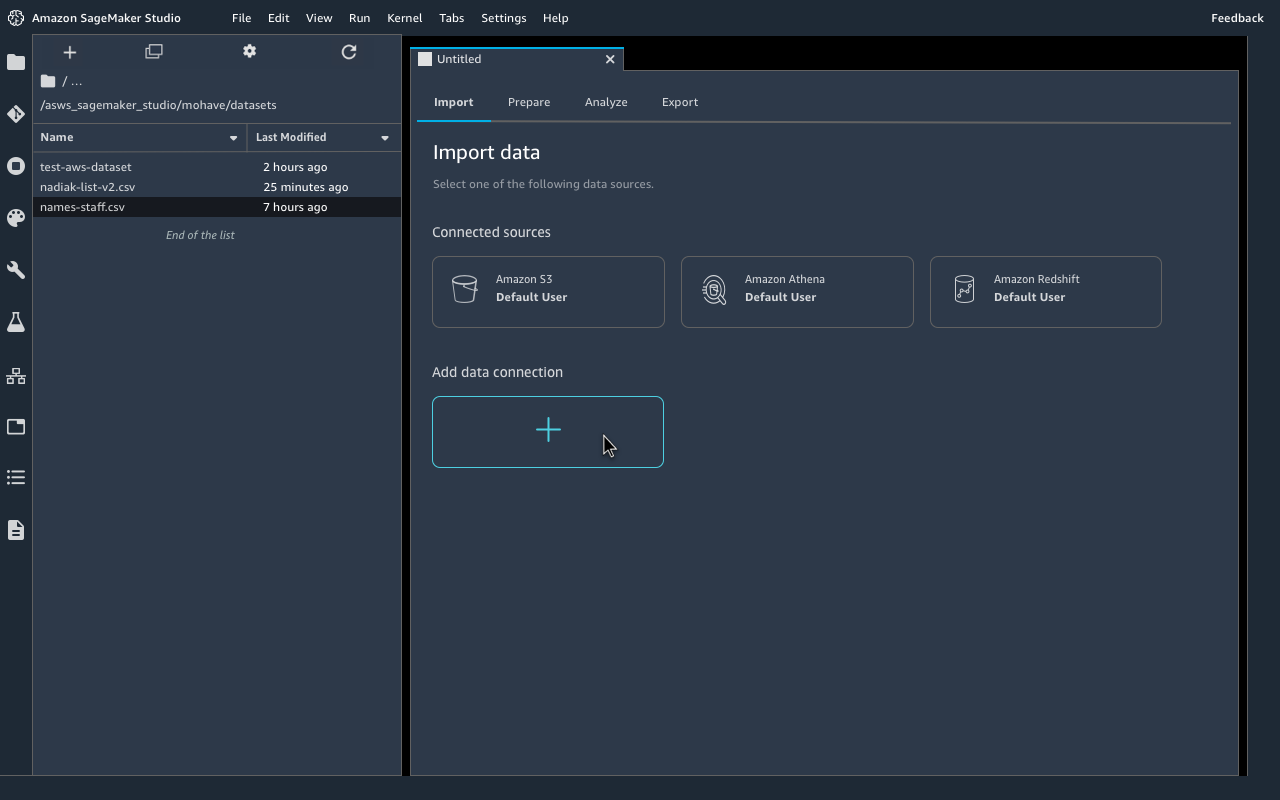
AWS launches SageMaker Data Wrangler, a new data preparation service for machine learning

AWS launched a new service today, Amazon SageMaker Data Wrangler, that makes it easier for data scientists to prepare their data for machine learning training. In addition, the company is also launching SageMaker Feature Store, available in the SageMaker Studio, a new service that makes it easier to name, organize, find and share machine learning features.

AWS is also launching Sagemaker Pipelines, a new service that’s integrated with the rest of the platform and that provides a CI/CD service for machine learning to create and automate workflows, as well as an audit trail for model components like training data and configurations.

As AWS CEO Andy Jassy pointed out in his keynote at the company’s re:Invent conference, data preparation remains a major challenge in the machine learning space. Users have to write their queries and the code to get the data from their data stores first, then write the queries to transform that code and combine features as necessary. All of that is work that doesn’t actually focus on building the models but on the infrastructure of building models.

Data Wrangler comes with over 300 pre-configured data transformation built-in, that help users convert column types or impute missing data with mean or median values. There are also some built-in visualization tools to help identify potential errors, as well as tools for checking if there are inconsistencies in the data and diagnose them before the models are deployed.

All of these workflows can then be saved in a notebook or as a script so that teams can replicate them — and used in SageMaker Pipelines to automate the rest of the workflow, too.


It’s worth noting that there are quite a few startups that are working on the same problem. Wrangling machine learning data, after all, is one of the most common problems in the space. For the most part, though, most companies still build their own tools and as usual, that makes this area ripe for a managed service.


from Amazon – TechCrunch https://ift.tt/33v6gqX
via IFTTT

AWS announces high resource Lambda functions, container image support & millisecond billing

AWS announced some big updates to its Lambda serverless function service today. For starters, starting today it will be able to deliver functions with up to 10MB of memory and 6 vCPUs (virtual CPUs). This will allow developers building more compute-intensive functions to get the resources they need.

“Starting today, you can allocate up to 10 GB of memory to a Lambda function. This is more than a 3x increase compared to previous limits. Lambda allocates CPU and other resources linearly in proportion to the amount of memory configured. That means you can now have access to up to 6 vCPUs in each execution environment,” the company wrote in a blog post announcing the new capabilities.

Serverless computing doesn’t mean there are no servers. It means that developers no longer have to worry about the compute, storage and memory requirements because the cloud provider — in this case, AWS — takes care of it for them, freeing them up to just code the application instead of deploying resources.

Today’s announcement combined with support for support for the AVX2 instruction set, means that developers can use this approach with more sophisticated technologies like machine learning, gaming and even high performance computing.

One of the beauties of this approach is that in theory you can save money because you aren’t paying for resources you aren’t using. You are only paying each time the application requires a set of resources and no more. To make this an even bigger advantage, the company also announced, “Starting today, we are rounding up duration to the nearest millisecond with no minimum execution time,” the company announced in a blog post on the new pricing approach.

Finally the company also announced container image support for Lambda functions. “To help you with that, you can now package and deploy Lambda functions as container images of up to 10 GB in size. In this way, you can also easily build and deploy larger workloads that rely on sizable dependencies, such as machine learning or data intensive workloads,” the company wrote in a blog post announcing the new capability.

All of these announcements in combination mean that you can now use Lambda functions for more intensive operations than you could previously, and the new billing approach should lower your overall spending as you make that transition to the new capabilities.


from Amazon – TechCrunch https://ift.tt/3lnZrO5
via IFTTT

AWS launches Trainium, its new custom ML training chip

At its annual re:Invent developer conference, AWS today announced the launch of AWS Trainium, the company’s next-gen custom chip dedicated to training machine learning models. The company promises that it can offer higher performance than any of its competitors in the cloud, with support for TensorFlow, PyTorch and MXNet.

It will be available as EC2 instances and inside Amazon SageMaker, the company’s machine learning platform.

New instances based on these custom chips will launch next year.

The main arguments for these custom chips are speed and cost. AWS promises 30% higher throughput and 45% lower cost-per-inference compared to the standard AWS GPU instances.

In addition, AWS is partnering with Intel to launch Habana Gaudi-based EC2 instances for machine learning training. Coming next year, these instances promise to offer up to 40% better price/performance compared to the current set of GPU-based EC2 instances for machine learning. These chips will support TensorFlow and PyTorch.

These new chips will make their debut in the AWS cloud in the first half of 2021.

Both of these new offerings complement AWS Inferentia, which the company launched at last year’s re:Invent. Inferentia is the inferencing counterpart to these machine learning pieces, which also uses a custom chip.

Trainium, it’s worth noting, will use the same SDK as Inferentia.

“While Inferentia addressed the cost of inference, which constitutes up to 90% of ML infrastructure costs, many development teams are also limited by fixed ML training budgets,” the AWS team writes. “This puts a cap on the scope and frequency of training needed to improve their models and applications. AWS Trainium addresses this challenge by providing the highest performance and lowest cost for ML training in the cloud. With both Trainium and Inferentia, customers will have an end-to-end flow of ML compute from scaling training workloads to deploying accelerated inference.”


from Amazon – TechCrunch https://ift.tt/37otr7N
via IFTTT

How to Add Text in Borders Using Basic HTML Elements

Some HTML elements come with preset designs, like the inconveniently small squares of <input type="checkbox"> elements, the limited-color bars of <meter> elements, and the “something about them bothers me” arrows of the <details> elements. We can style them to match the modern aesthetics of our websites while making use of their functionalities. There are also many elements that rarely get used as both their default appearance and functionality are less needed in modern web designs.

One such HTML element is <fieldset>, along with its child element <legend>.

A <fieldset> element is traditionally used to group and access form controls. We can visually notice the grouping by the presence of a border around the grouped content on the screen. The caption for this group is given inside the <legend> element that’s added as the first child of the <fieldset>.

This combination of <fieldset> and <legend> creates a unique ready-made “text in border” design where the caption is placed right where the border is and the line of the border doesn’t go through the text. The border line “breaks” when it encounters the beginning of the caption text and resumes after the text ends.

In this post, we’ll make use of the <fieldset> and <legend> combo to create a more modern border text design that’s quick and easy to code and update.

For the four borders, we need four <fieldset> elements, each containing a <legend> element inside. We add the text that will appear at the borders inside the <legend> elements.

<fieldset><legend>Wash Your Hands</legend></fieldset>
<fieldset><legend>Stay Apart</legend></fieldset>
<fieldset><legend>Wear A Mask</legend></fieldset>
<fieldset><legend>Stay Home</legend></fieldset>

To begin, we stack the <fieldset> elements on top of each other in a grid cell and give them borders. You can stack them using any way you want — it doesn’t necessarily have to be a grid.

Only the top border of each <fieldset> element is kept visible while the remaining edges are transparent since the text of the <legend> element appears at the top border of the <fieldset> by default.

Also, we give all the <fieldset> elements a box-sizing property with a value of border-box so the width and height of the <fieldset> elements include their border and padding sizes too. Doing this later creates a leveled design, when we style the <legend> elements.

body {
  display: grid; 
  margin: auto; /* to center */
  margin-top: calc(50vh - 170px); /* to center */
  width: 300px; height: 300px; 
}

fieldset {
  border: 10px solid transparent; 
  border-top-color: black; 
  box-sizing: border-box; 
  grid-area: 1 / 1; /* first row, first column */
  padding: 20px; 
  width: inherit; 
}

After this, we rotate the last three <fieldset> elements in order to use their top borders as the side and bottom borders of our design.

/* rotate to right */
fieldset:nth-of-type(2){ transform: rotate(90deg); }
/* rotate to bottom */
fieldset:nth-of-type(3){ transform: rotate(180deg); }
/* rotate to left */
fieldset:nth-of-type(4){ transform: rotate(-90deg); }

Next up is styling the <legend> elements. The key to create smooth border text using a <legend> element is to give it a zero (or small enough) line-height. If it has a large line height, that will displace the position of the border it’s in, pushing the border down. And when the border moves with the line height, we won’t be able to connect all the four sides of our design and will need to readjust the borders.

legend {
  font: 15pt/0 'Averia Serif Libre'; 
  margin: auto; /* to center */
  padding: 0 4px; 
}

fieldset:nth-of-type(3) > legend { 
  transform: rotate(180deg);
}

I used the font shorthand property to give the values for the font-size, line-height and font-family properties of the <legend> elements.

The <legend> element that adds the text at the bottom border of our design, fieldset:nth-of-type(3)>legend, is upside-down because of its rotated <fieldset> parent element. Flip that <legend> element vertically to show its text right-side-up.

Add an image to the first <fieldset> element and you get something like this:

Lateral margins can move the text along the border. Left and right margins with auto values will center the text, as seen in the above Pen. Only the left margin with an auto value will flush the text to the right, and vice versa, for the right margin.

Bonus: After a brief geometrical detour, here’s an octagonal design I made using the same technique:


The post How to Add Text in Borders Using Basic HTML Elements appeared first on CSS-Tricks.

You can support CSS-Tricks by being an MVP Supporter.


from CSS-Tricks https://ift.tt/37i8kDO
via IFTTT

Under-Engineered Responsive Tables

I first blogged about responsive data tables in 2011. When responsive web design was first becoming a thing, there were little hurdles like data tables that had to be jumped. The nature of <table> elements are that they have something a minimum width depending on the content they contain and that can easily exceed the width of a small screen device.

This image I made then still covers the issue pretty well:

Except… maybe they don’t equally suck. If that image on the left were scrollable, then maybe that’s actually… not so bad. In fact, that’s what I’ve done right here on CSS-Tricks recently. I think it’s the safest way of handling responsive tables when you have no idea what content the table contains. That’s the case here, where I need to set up base table styles that apply to any blog post which may contain a table.

The crux of the idea of a scrollable table is to wrap it in a <div> that has overflow: auto; on it. That way the <table> inside is free to exceed the width of the parent, but it won’t “blow out the width” and instead triggers a scrollbar. This isn’t quite enough though, so here’s Adrian Roselli with the real scoop. The wrapping <div> needs to be focusable and labelled, so:

<div role="region" aria-labelledby="Caption01" tabindex="0">
  <table>
    <caption id="Caption01">Appropriate caption</caption>
    <!-- ...  -->
  </table>
</div>

Then apply the scrolling and focus styles, in the condition you’ve done everything else right:

[role="region"][aria-labelledby][tabindex] {
  overflow: auto;
}

[role="region"][aria-labelledby][tabindex]:focus {
  outline: .1em solid rgba(0,0,0,.1);
}

If you’re going to further engineer responsive tables, there are all sorts of options. One of the classics is to display: block a lot of the elements, meaning that all the data in a row (<tr>) ends up as a chunk of stacked content together that stands less of a chance of breaking the parent element’s width. You can get all the data labels properly with pseudo-elements. But, this only makes sense when individual rows of content make perfect sense alone. That’s not the case with every table. A table’s purpose might be cross-referencing data, and in that case, you’ve ruined that with this approach. So again, there are nice approaches for responsive tables when you know exactly the content and purpose of the table. But the best responsive solution when you don’t know is to just make sure they are swipeable.

Direct Link to ArticlePermalink


The post Under-Engineered Responsive Tables appeared first on CSS-Tricks.

You can support CSS-Tricks by being an MVP Supporter.


from CSS-Tricks https://ift.tt/2UFGTy5
via IFTTT

U.S. shopping app downloads on Black Friday reached a record 2.8M installs

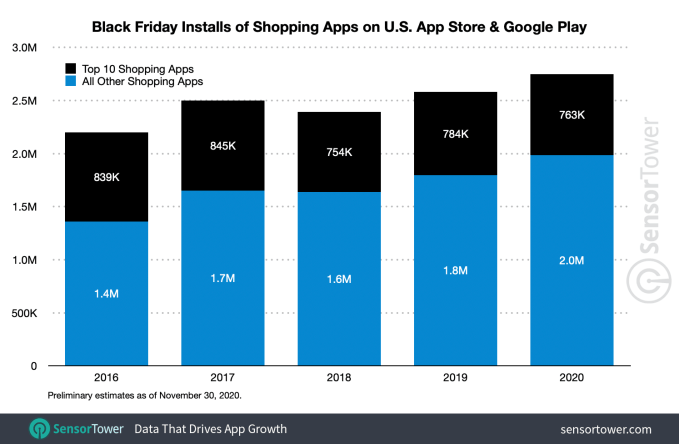
Many U.S. consumers spent this year’s Black Friday sales event shopping from home on mobile devices. That led to first-time installs of mobile shopping apps in the U.S. to break a new record for single-day installs on Black Friday 2020, according to a report from Sensor Tower. The firm estimates that U.S. consumers downloaded approximately 2.8 million shopping apps on November 27th — a figure that’s up by nearly 8% over last year.

However, this number doesn’t necessarily represent faster growth than in 2019, which also saw about an 8% year-over-year increase in Black Friday shopping app installs, the report noted. This could be because mobile shopping and the related app installs are now taking place throughout the month of November, though, as retailers adjusted to the pandemic and other online shopping trends by hosting earlier sales or even month-long sales events.

Image Credits: Sensor Tower

The data seems to indicate this is true. Between Nov. 1 and Nov. 29, U.S. consumers downloaded approximately 59.2 million shopping apps from across the App Store and Google Play — an increase of roughly 15% from the 51.7 million they downloaded in Nov. 2019. That’s a much higher figure than the 2% year-over-year growth seen during this same period in 2019.

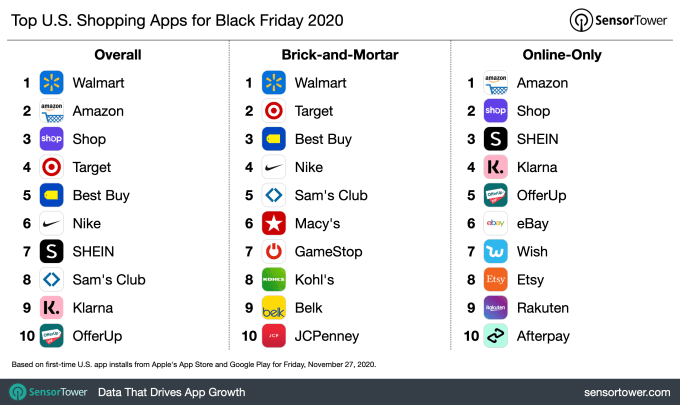
Another shift taking place in mobile shopping is the growing adoption of app from brick-and-mortar retailers. During the first three quarters of 2020, apps from brick-and-mortar retailers grew installs 27%. This trend continued on Black Friday, when 5 out of the top 10 mobile shopping apps were those from brick-and-mortar retailers, led by Walmart.

Image Credits: Sensor Tower

Walmart saw the highest adoption this year, with around 131,000 Black Friday installs, followed by Amazon at 106,000, then Shopify’s Shop at 81,000. Combined, the top 10 apps saw 763,000 total new installs, or 27% of the first-time downloads in the Shopping category.

Because the firms are only looking at new app installs, they aren’t giving a full picture of the U.S. mobile shopping market, as many consumers already have these apps installed on their devices. And many more simply shop online via a desktop or laptop computer.

To give these figures some context, Shopify reported on Saturday it had seen record Black Friday sales of $2.4 billion, with 68% on mobile. And today, Amazon announced its small business sales alone topped $4.8 billion from Black Friday to Cyber Monday, a 60% year-over-year increase, but it didn’t break out the percentage that came from mobile.

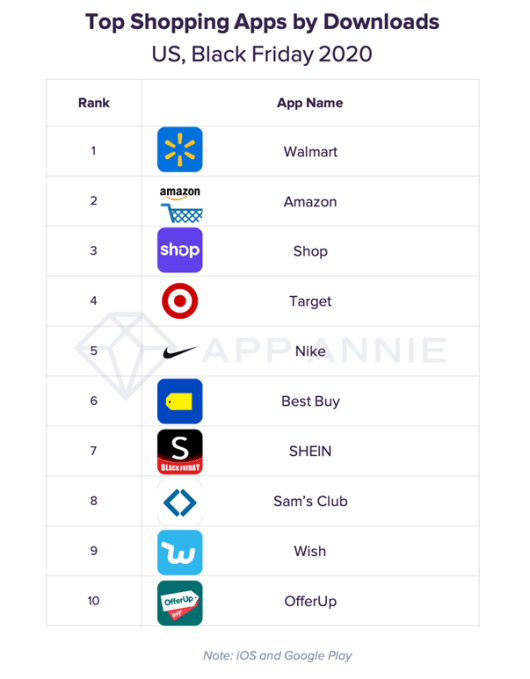
Sensor Tower and rival app store analytics firm App Annie largely agreed on the top 5 shopping apps downloaded this Black Friday. They both saw Walmart again beating Amazon to become the most-downloaded U.S. shopping app on Black Friday — as it did in 2019. The two firms reported that Amazon remained No. 2 by downloads, followed by Shopify’s Shop app, then Target. However, Sensor Tower put Best Buy in 5th place, followed by Nike, while App Annie saw those positions swapped.

Image Credits: App Annie

The rest of Sensor Tower’s top 10 included SHEIN, Sam’s Club, Klarna, then Offer Up, while App Annie’s list was rounded out by SHEIN, Sam’s Club, Wish, then Offer Up.

The pandemic’s impact may not have been obvious given the growth in online shopping this year, but the recession it triggered has played a role in how U.S. consumers are paying for their purchases. “Buy Now, Pay Later” apps like Klarna were up this year, even breaking into the top 10 per Sensor Tower’s data. The firm also noted that many new shopping apps launched this year focused on discounts and deals and retailers ran longer sales this year, as well.


from Amazon – TechCrunch https://ift.tt/3fShrzc
via IFTTT

Monday, November 30, 2020

Mostly Clear today!


With a high of F and a low of 22F. Currently, it's 24F and Clear outside.

Current wind speeds: 7 from the Southwest

Pollen: 0

Sunrise: November 30, 2020 at 07:51PM

Sunset: December 1, 2020 at 05:29AM

UV index: 0

Humidity: 35%

via https://ift.tt/2livfew

December 1, 2020 at 10:00AM

Showers Early today!

With a high of F and a low of 65F. Currently, it's 82F and Clear outside. Current wind speeds: 9 from the Southeast Pollen: 3 Su...